

A rental may feel hands-off to its owner, but it never runs itself. A managed vacation rental can be a good hands-off investment when its income potential, operating costs, and demands on your time align with your goals, and professional management meaningfully reduces day-to-day work.
The appeal is easy to see: a welcoming home in Northern Michigan can give travelers a place to unwind while offering you an investment with a different rhythm from a traditional rental. But income can vary by season, local rules affect how you can operate the property, and management shapes both your workload and returns. This guide explores four questions to help you weigh the tradeoffs, from rental income and diversification to seasonality, local regulations, and full-service management. Whether you’re considering a property near Charlevoix, Petoskey, Boyne City, or Traverse City, you’ll get a clearer sense of whether this investment fits your plans.
Key Takeaways
- Assess a vacation rental by its potential income after operating costs, not by booking revenue alone.
- Consider how adding real estate could diversify your investments while weighing its distinct costs and responsibilities.
- Account for seasonal demand and local regulations when evaluating a property in Northern Michigan.
- Explore how full-service management could reduce day-to-day tasks, while factoring its effect on investment returns.
1. Are Vacation Rentals a Good Investment?
A vacation rental can build wealth through operating cash flow and property appreciation. Assess these as separate parts of your real estate analysis. Rental revenue is not profit: subtract mortgage payments, maintenance, repairs, advertising, and hosting expenses before estimating cash flow. A listing with strong booking revenue can still generate limited income after operating costs. This distinction matters when deciding whether the investment supports your financial goals.
Financing shapes the calculation before the first guest arrives. Mortgage lenders usually require at least a 25% down payment on an investment-property purchase. Build the financing plan around that requirement, then account for ongoing expenses before projecting rental income. Appreciation is separate from current cash flow. Model the property’s operating performance first, then consider how a change in value could affect longer-term returns.
Market selection matters, too. For a property in Charlevoix, Petoskey, or Traverse City, compare likely revenue with the costs of maintaining that specific home. Review local listing rates, seasonal booking patterns, property condition, and nearby alternatives. Apply the same assumptions across markets for a fair comparison. An area-wide average can conceal important differences between a waterfront home and a smaller property farther inland.
Potential tax deductions may improve the financial picture. Depending on the owner’s situation, mortgage interest, repairs and maintenance, advertising, and other hosting-related expenses may qualify. Keep records of rental income and expenses so the property’s operating results are clear. Personal use can also affect tax treatment. According to the Internal Revenue Service, under the described business-use test, owners may use a property personally for less than 14 days or less than 10% of its rental days, whichever is greater.
For a grounded decision, compare projected revenue with financing and operating costs, then distinguish expected cash flow from possible appreciation. Consider whether personal stays fit the property’s intended use and tax treatment. A vacation rental may suit an investor seeking real estate exposure and potential passive income, but the numbers depend on the property, its market, and its operating plan.
2. Short-term rental income and portfolio diversification
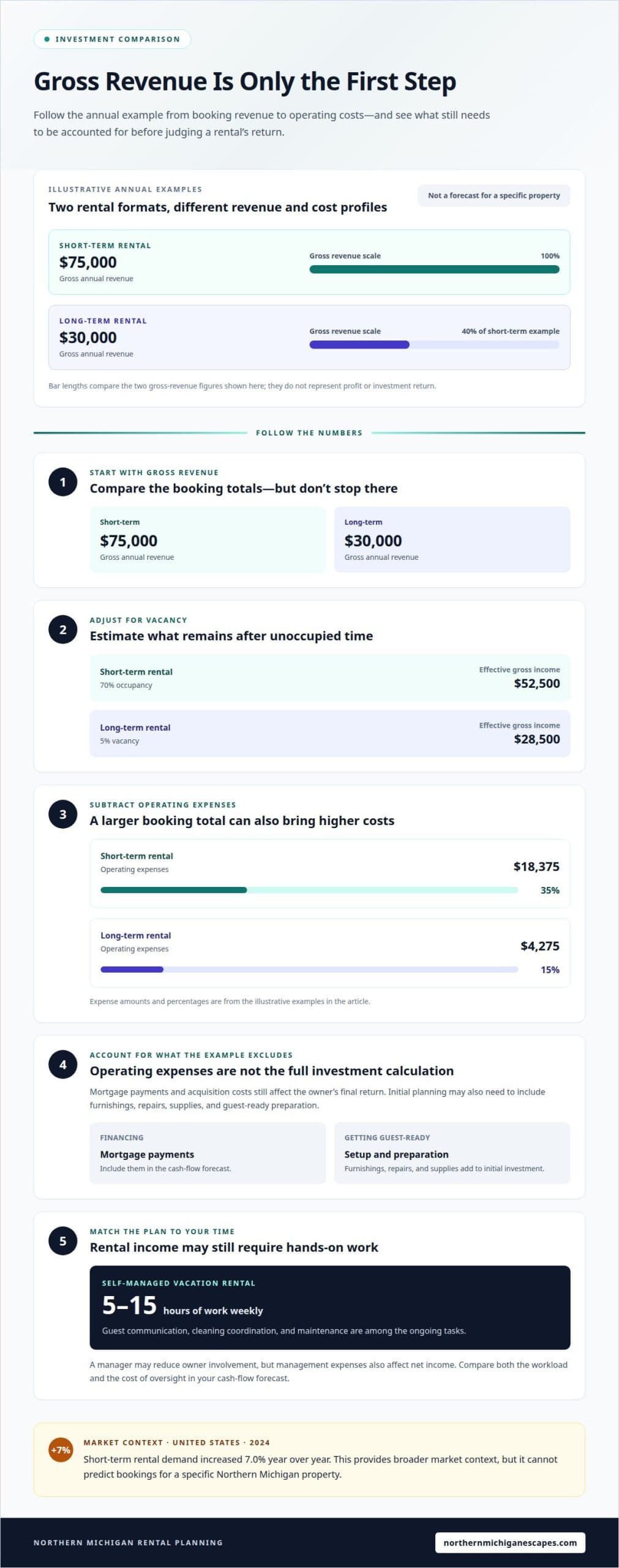
Short-term rentals can add real estate exposure alongside stocks, bonds, or other assets. Their income comes from guest bookings, so performance depends on nightly rates, occupied dates, and operating costs. In the United States, short-term rental demand increased 7.0% year over year in 2024. That market signal offers context, but it cannot predict bookings for a specific Northern Michigan property.
Compare rental formats using the same assumptions. One illustrative example estimates a short-term rental’s gross annual revenue at $75,000, with 70% occupancy. After vacancy, effective gross income is $52,500, and operating expenses at 35% total $18,375. A long-term rental example uses $30,000 gross revenue, 5% vacancy, and $28,500 effective gross income. At 15% operating expenses, costs total $4,275. These examples show why higher gross revenue alone doesn’t establish higher profit. Mortgage payments and acquisition costs still affect the owner’s final return.
Acquisition planning involves more than the purchase price. Furnishings, repairs, supplies, and guest-ready preparation add to the initial investment. Estimate these costs alongside mortgage payments, then assess whether expected income can support the property during quieter periods. Diversification works best when the rental’s financial demands fit your broader portfolio, rather than depending on optimistic booking assumptions.
There’s also a difference between rental income and passive income. A self-managed vacation rental typically requires 5 to 15 hours of work weekly, including guest communication, cleaning coordination, and maintenance. A manager may reduce owner involvement, but management expenses also affect net income. Decide how much time you’ll contribute, then compare self-management and professional oversight in your cash-flow forecast.
For a Northern Michigan property, compare demand, likely booking patterns, and operating needs in places such as Charlevoix, Boyne City, and Traverse City. A Northern Michigan vacation rental can be assessed as one part of a wider investment plan, with income potential weighed against costs, workload, and the value of diversification.
3. Seasonality and local short-term rental regulations
In Northern Michigan, guest demand can shift with the season, local events, and travel patterns. A lakeside property near Charlevoix may appeal to summer visitors, while Boyne Falls can draw guests for winter recreation. These markets have different booking patterns, so don’t treat their income assumptions as interchangeable. Estimate occupancy across the full calendar and account for quieter periods instead of projecting peak-season performance into every month.
Seasonality also affects pricing and cash flow. Short-term rental owners can adjust rates to local trends and charge more during high season than they might receive from a monthly tenant. That flexibility helps only if your investment plan accounts for vacancies between bookings. Compare expected nightly demand with costs that continue during slower periods, such as utilities, upkeep, and mortgage payments. A management plan should also account for changing guest needs throughout the year.
Local rules are another part of operating a rental. Short-term rental requirements can differ between municipalities, so identify the city, township, and county jurisdictions that apply to a property in Petoskey, East Jordan, or Traverse City. Review local regulations, registration or permit processes, and tax obligations before including rental revenue in your projections. Record applicable requirements and renewal dates so compliance tasks become part of your annual operating plan.
Private restrictions may matter as much as public regulations. If a condominium or home is governed by a homeowners association, review its governing documents for rental limits, minimum stays, guest rules, or approval processes. These terms can limit how often the property may host travelers, even when local rules allow short-term stays. Include those limits in occupancy estimates rather than assuming every date is available.
For an investment in Harbor Springs or Boyne City, assess seasonality, local regulations, and association restrictions together. A practical sequence is to map demand by season, identify the governing jurisdictions, review property-level rules, and then adjust the revenue forecast. This gives you a more realistic view of whether the local rental market fits your investment strategy.
4. Full-service vacation rental management
Full-service management can shift routine hosting tasks away from owners, but you still need to assess performance. For a property near Petoskey, clarify how management handles guest inquiries, booking coordination, housekeeping, and property maintenance. These details shape your workload and the guest experience, from the first reservation message to preparing the home between stays.
Start by mapping responsibilities. Identify who sets rates, manages reservations, arranges housekeeping, responds to maintenance needs, and reports rental activity. Then distinguish the manager’s tasks from decisions that remain yours, such as approving major repairs or setting personal-use dates. A clear division shows what “hands-off” means in practice, rather than assuming every decision transfers automatically.
Management also affects net income. Evaluate the agreement’s expenses alongside projected revenue, mortgage payments, upkeep, and seasonal vacancies. A property in Charlevoix may have different booking patterns and maintenance needs from one in Traverse City, so assess the operating plan for the specific home. Financing terms influence cash flow, while the management arrangement affects your time and responsibilities. Compare net results, not just potential gross revenue.
Guests see service quality in the details: prepared rooms, clear arrival information, and timely attention to property issues. Professional housekeeping and property maintenance can support consistent care, while owners still need insight into bookings, expenses, and property condition. Set a regular reporting process in the management arrangement, then use those records to review performance and adjust your investment strategy.
Full-service management is most useful when owners want less involvement in guest operations but still expect to monitor financial and property decisions. It may be a poorer fit for owners who prefer direct control over each booking or want to handle guest communication themselves. For a Northern Michigan rental, explore full-service property management as one way to structure hosting, housekeeping, and property care around your goals.
Northern Michigan Escapes
Northern Michigan Escapes can help connect your investment decision with the realities of owning and operating a vacation property. If you’re weighing a purchase, its Real Estate Sales and Acquisitions offering can support your search, while Full-Service Property Management handles the ongoing work of hosting and property care. Together, these services help you consider both the property and the time involved in managing it.
For owners focused on a particular destination, Northern Michigan Escapes offers Lake Charlevoix and Harbor Springs vacation rentals. These local options can help ground your investment research in the communities you’re considering, including Charlevoix and Harbor Springs.
If you’re exploring a vacation property or considering professional management, contact Northern Michigan Escapes to discuss your goals.
Choose a Next Step That Fits Your Goals
Before moving forward, write down what you want the property to do: generate income, provide personal getaway time, or balance both. Then decide how involved you want to be and which financial tradeoffs suit your plans. Asking whether a managed vacation rental is a good hands-off investment becomes more useful when you assess it against those priorities, rather than an imagined ideal of effortless income.
If you’re considering a Northern Michigan purchase, connect the investment question to the location and property type. Northern Michigan Escapes offers Real Estate Sales and Acquisitions, along with vacation rentals in destinations including Lake Charlevoix and surrounding areas. This regional perspective can help you consider how a property decision and its management needs fit together. A clear sense of your goals gives the conversation a practical starting point, whether you’re researching a purchase or considering management for a property you own.
Contact Northern Michigan Escapes to discuss your next step, and begin shaping an investment plan that feels right for you.
Frequently Asked Questions
Are Vacation Rentals a Good Investment?
A vacation rental can suit investors whose financial goals and ownership plans align with its income potential and operating demands. To decide whether a managed vacation rental is a good hands-off investment, consider how much time you want to spend overseeing the property and what net income you need. In Northern Michigan, compare local demand and property needs in Boyne City, Boyne Falls, Charlevoix, East Jordan, Harbor Springs, Petoskey, and Traverse City.
What does a managed vacation rental investment include, and what tasks does the manager handle?
A managed rental combines property ownership with professional coordination of guest stays and property care. If you’re weighing whether a managed vacation rental is a good hands-off investment, review the management agreement closely. It defines responsibilities such as booking coordination, guest relations, financial reporting, and property care. Clarify which decisions remain yours, including oversight of the investment and significant property matters.
What are typical vacation rental management fees in the United States?
Vacation rental management fees vary by agreement and service scope, and may be percentage-based. Northern Michigan Escapes charges percentage-based property management fees. Costs vary, and a quote is provided upon request. Cost factors include booking coordination, marketing, guest relations, financial reporting, and property-care oversight. Compare the responsibilities covered by an agreement, since a fee’s value depends on the work included and your needs as an owner.
What is the average net return on a managed vacation rental after operating expenses?
There is no single net-return figure that applies to every managed vacation rental. Calculate results by subtracting operating expenses, management costs, financing, and unbooked periods from rental income. A home with strong bookings may still produce modest net income if maintenance or mortgage costs are high. Use consistent accounting periods and expense categories to evaluate performance and see how the property contributes to your wider investment goals.
How do vacation rental returns compare with long-term rentals, REITs, and index funds?
Returns depend on the property and the risks you accept, so there’s no universal ranking. A vacation rental involves direct property ownership and related operating decisions, while long-term rentals follow a different tenant and leasing pattern. REITs and index funds provide market exposure without managing guest stays. Compare liquidity, diversification, workload, expenses, and income needs alongside projected returns before choosing between them.
What upfront and ongoing costs should vacation rental owners budget for?
Plan for acquisition and setup expenses, then estimate recurring costs before projecting profit. A budget may include furnishings, repairs, insurance, taxes, utilities, maintenance, housekeeping, management, mortgage payments, and preparing the property between stays. For a waterfront home near Charlevoix, include property upkeep alongside guest supplies. Set aside funds for slower booking periods, too, since expenses can continue when reservations are fewer.