

A higher cap rate can look appealing, but it doesn’t tell the whole story of a vacation property’s performance. To learn how to calculate cap rate on a short-term rental, divide annual net operating income by the property’s value, then multiply by 100 to express the result as a percentage. A broad benchmark for short-term rentals is 4% to 10%, but local demand, seasonal income, expenses, and risk all shape what makes sense for a particular property.
It’s natural to want one clear number when comparing investment options. For a useful comparison, focus on properties with similar locations and operating assumptions, whether you’re considering a lakeside home near Charlevoix or a getaway in Traverse City. This guide explains how to calculate cap rate on a short-term rental, which costs to include in net operating income, and how to compare local properties while accounting for the measure’s limits and other performance indicators.
Key Takeaways
- Use net operating income and property value to assess a rental’s income yield, then compare properties using consistent assumptions.
- Build realistic revenue projections around nightly rates, occupancy, and seasonal demand in the property’s local market.
- Include operating costs such as management, taxes, utilities, insurance, and maintenance when estimating income.
- Treat cap rate as one useful measure, not a complete forecast of financing costs, major repairs, or changing income.
- Pair cap rate with other performance measures to get a fuller view of a vacation rental investment.
What is a good cap rate for investment properties?
A short-term rental cap rate of 4% to 10% is commonly considered good, but that range doesn’t settle whether a property suits your goals. Long-term rental properties are also described as generally good at 5% to 10%, so the ranges overlap; compare similar markets and account for short-term rental seasonality.
Start with realistic annual income and operating expenses. Then compare net operating income with the property’s purchase price or current market value.
Watch this overview of rental-property analysis before working through the calculation:
-
Calculate Short-Term Rental NOI
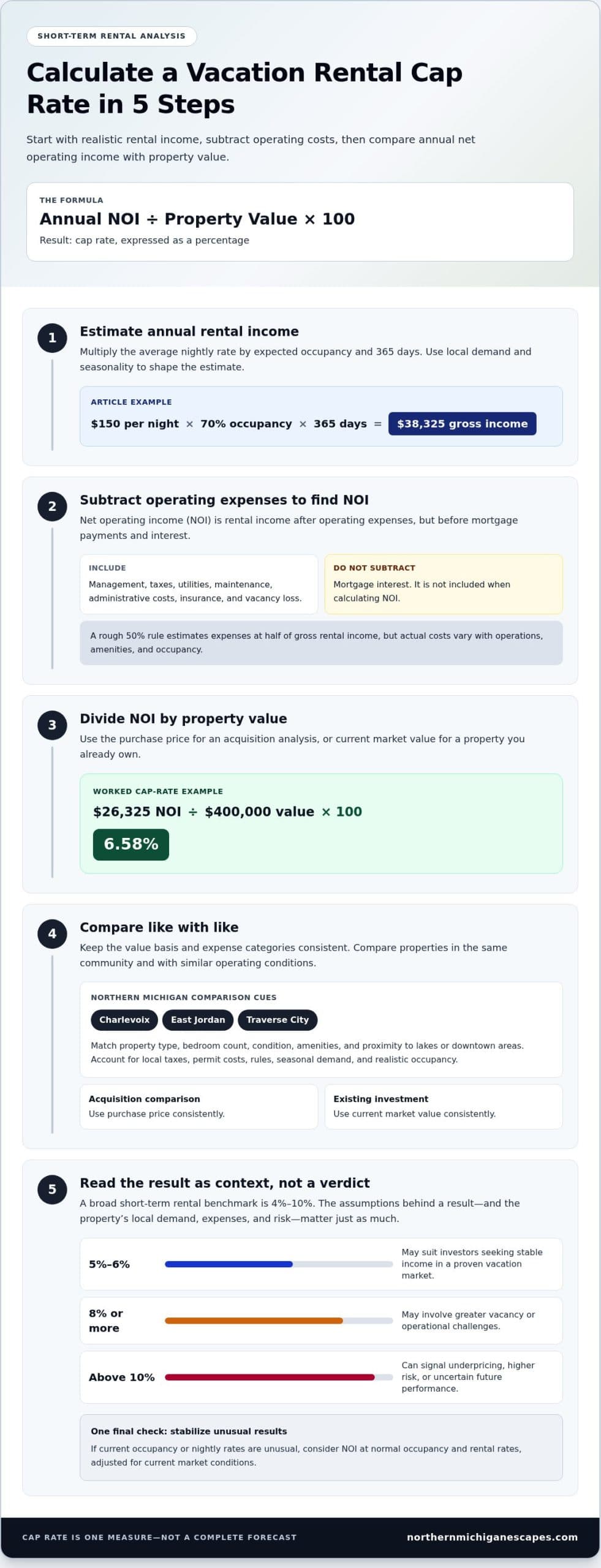
Estimate annual gross rental income by multiplying the average nightly rate by expected occupancy and 365 days. For example, $150 per night at 70% occupancy projects $38,325 in annual gross income. Subtract operating expenses, including vacancy loss, management, taxes, utilities, maintenance, administrative costs, and insurance. Don’t subtract mortgage interest when calculating NOI.
- Use actual or carefully projected operating costs rather than assuming every booked night produces the full nightly rate. A rough 50% rule estimates that expenses consume half of gross rental income, but short-term rental costs vary with operations, amenities, and occupancy. Recurring amenity income, such as laundry or parking fees, can also affect NOI.
-
Apply NOI to Property Value
Divide annual NOI by the purchase price, then multiply by 100 to express the cap rate as a percentage. The same formula can use current market value when assessing a property you already own. With $26,325 in NOI and a $400,000 value, the calculation is $26,325 ÷ $400,000 × 100, or 6.58%.
- Keep the denominator consistent when comparing properties: use the purchase price for an acquisition analysis or current market value for an existing investment. Don’t compare one property’s cap rate based on its listing price with another’s based on a lower purchase price. A change in value can shift the percentage even when NOI stays the same.
- Compare the result with local expectations, not as a stand-alone verdict. A 5% to 6% cap rate may suit investors seeking stable income in a proven vacation market, while 8% or more may involve greater vacancy or operational challenges. A result above 10% can also point to underpricing, higher risk, or uncertain future performance.
- Use stabilized income when current results reflect unusual occupancy or nightly rates. The Board of Governors of the Federal Reserve System describes stabilized annual income as NOI at normal occupancy and rental rates, adjusted for current market conditions. This helps distinguish a property’s typical earning pattern from an unusually strong or weak year.
Evaluating local short-term rental markets and comparable properties
A useful comparison starts with properties in the same market and similar operating conditions. Local taxes, permit costs, and short-term rental rules can affect expenses and the rental activity behind income estimates, so account for their practical effects in your projections.
- Define a close comparison set. In Northern Michigan, compare properties in the same community, such as Charlevoix, East Jordan, or Traverse City, rather than treating the region as one market. Match bedroom count, property type, condition, amenities, and proximity to lakes or downtown areas. A waterfront home and an inland condo may attract different guests and seasonal demand, making their income and values harder to compare directly. Distinctive boutique accommodations, such as The Historic Arnott Bakehouse, serve as an example of how unique heritage appeal can attract a dedicated guest niche and influence operating performance.
- Use cap-rate ranges as context, not targets. Vacation properties in strong U.S. leisure markets may show cap rates from 6% to 10% or higher. Other market guidance describes 5% to 7% as balanced in many mid-tier vacation markets, while 8% to 10% may appear in less competitive or seasonal locations and can involve more risk. Local demand and operating costs determine how useful these comparisons are.
- Estimate property value from NOI and a selected cap rate by dividing NOI by the cap rate expressed as a decimal. For example, $20,000 in annual NOI at a 10% cap rate implies an estimated value of $200,000. Treat this as a screening estimate, not a listing price: the chosen rate reflects perceived risk, local competition, property condition, and the stability of expected income.
- Use the same expense categories for every comparable property. Include maintenance, property taxes, insurance, utilities, management, and administrative costs in annual operating expenses. Taxes and insurance vary by property and location, while maintenance depends on condition and use. For a short-term rental, account for seasonal demand and realistic occupancy rather than assuming the property earns income every night.
- Screen investments by comparing both the cap rate and the assumptions behind it. Check whether projected nightly rates, occupancy, and expenses fit the property’s location and condition. A high estimated return may reflect greater vacancy, repairs, or uncertainty, while a lower rate may accompany stronger demand or a higher property value. For a local sense of property types and settings, browse Northern Michigan vacation rentals as a comparison reference.
How Do You Calculate the Cap Rate?
Cap rate expresses a property’s annual operating income as a percentage of its value. Follow the same calculation steps for a short-term rental, then examine the assumptions behind the result.
-
Identify the NOI and Property Value
Start with annual net operating income, or NOI, and the property value you’re evaluating. NOI is rental income after operating expenses but before mortgage payments and interest. Use the purchase price to assess an acquisition, or current market value to review an owned property. Keep the income period and valuation basis consistent so you’re comparing like with like.
- Write down each input separately before calculating. For example, a short-term rental with $80,000 in annual gross rental income and $25,000 in annual operating expenses has $55,000 in annual NOI. The property’s current market value in this example is $700,000. These figures provide the numerator and denominator for the calculation.
-
Divide NOI by Property Value
Divide annual NOI by property value to find the decimal cap rate, then multiply by 100 to convert it into a percentage. Using the example, $55,000 divided by $700,000 equals approximately 0.0786. Multiplying by 100 gives a cap rate of 7.86%. Keep the decimal step; skipping it or reversing the inputs produces an incorrect result.
- Check that the result reflects operating performance, not financing. Cap rate doesn’t subtract mortgage principal or interest, so two buyers financing the same property differently can calculate the same cap rate, even though their cash flow after debt payments may differ. Use cap rate to compare property income with value, not as a measure of every investor’s personal return.
- Use the formula in reverse when estimating a potential property value: divide annual NOI by the desired cap rate written as a decimal. For instance, $20,000 in annual NOI divided by 0.10 gives an estimated value of $200,000. This calculation shows the value implied by that income and rate; it doesn’t establish a market sale price.
- Review occupancy and rental-income assumptions before relying on the percentage. A projection based on unusually high occupancy can overstate operating income if actual bookings fall short. Recalculate with income that reflects expected operating conditions, then compare the result with similarly positioned properties. A 5% cap rate suggests roughly 20 years to recover an investment, but that simple reading excludes financing and changes in property income or value.
Cap rate limitations, including financing and capital expenditures
NOI includes operating costs such as vacancy loss, management, taxes, utilities, maintenance, administrative costs, and insurance. Mortgage principal, interest, and other financing payments aren’t operating expenses in the cap rate formula, so cap rate doesn’t show the owner’s cash flow after debt payments.
- Separate ordinary operating expenses from financing costs. Include recurring costs of operating the rental, such as property taxes, insurance, utilities, management, and routine maintenance. Subtract vacancy loss from potential rental income. Don’t subtract mortgage interest or principal from NOI: financing terms vary between owners, and including them would make property-level comparisons less consistent.
- Budget for capital work outside the basic NOI calculation. A rough annual budgeting rule for rental-property repairs and capital expenditures is 1% of the property’s value. Treat this as a planning estimate, not as a substitute for identifying the property’s actual needs. A new roof or major system replacement can create a substantial cash outlay that an ordinary operating-year cap rate won’t reveal.
- Model seasonal income across the full year. Short-term rentals can have seasonal income fluctuations, variable occupancy, and unpredictable operating expenses. A projection based on peak-season bookings may overstate annual performance if quieter periods bring fewer reservations. Use expected occupancy and rates across all seasons rather than multiplying a busy month across the year.
- Stress-test vacancy and expense assumptions before relying on the result. Lower occupancy reduces rental income, while some costs, including insurance, taxes, and certain utilities, may continue. Recalculate NOI using more conservative bookings and higher operating costs to see how sensitive the cap rate is. Changes to both inputs can substantially shift the apparent return.
- Treat cap rate as one measure, not a complete investment forecast. It compares property-level NOI with property value, but excludes loan payments, major capital expenditures, and the owner’s financing structure. Two buyers can face different monthly debt obligations while evaluating the same property at the same cap rate. Assess cash flow separately when financing affects your decision.
- Use the result cautiously for seasonal vacation properties. Cap rate isn’t a reliable stand-alone measure for short-term or vacation rentals with seasonal income. It can still help screen properties, but its usefulness depends on realistic annual occupancy, consistent expense categories, and a clear distinction between routine operating costs and major capital work.
Tools for evaluating vacation rental performance
Use a comparison worksheet to connect local rental assumptions with a property’s expected income and purchase price. Base occupancy and nightly-rate estimates on actual operating statements and comparable local rental data, not listing prices alone.
-
Find Local Occupancy Data
Start with operating statements for comparable short-term rentals in the specific market. Separate booked nights from nights merely available, then compare properties with similar size, amenities, location, and seasonal appeal. A waterfront home in Charlevoix and a Traverse City condo may have different booking patterns, so broad regional averages can obscure useful distinctions. Track seasonal variation across the year, not just peak periods.
-
Find Local Nightly-Rate Data
Compare achieved nightly rates for similar rentals, not just advertised prices. Listings show asking prices; operating records show the rates associated with actual stays. Match bedroom capacity, property condition, amenities, and location before using a rate in your estimate; for instance, rural retreats like Wildside Highland Lodges illustrate how distinctive luxury cabin accommodations can drive premium rate potential. Keep seasonal pricing distinct, since a busy summer rate may not represent income during quieter periods.
- Build a simple worksheet with one row per comparable rental property. Record its location, property type, occupancy assumptions, nightly rates, annual rental income, operating expenses, and purchase price or market value. Use consistent categories and time periods for every row. This makes it easier to see whether a projected return reflects stronger income, lower expenses, or a different property value.
- Evaluate cap rate alongside cash-on-cash return. Cap rate compares net operating income with property value, while cash-on-cash return divides annual pre-tax cash flow by total cash invested, then multiplies by 100. For example, a $100,000 cash investment producing $10,000 after loan payments and expenses yields a 10% cash-on-cash return. The two measures answer different questions about performance and financing.
- Update your comparison when operating results change. Review actual occupancy, nightly rates, expenses, and debt-related cash flow against the original estimate. A stable return depends on the rental’s ability to earn income across its operating seasons, not just on a promising purchase projection. To explore property types and settings across the region, browse Northern Michigan vacation rentals as a starting point for refining your comparison.
Northern Michigan Escapes: Lake Charlevoix Vacation Rentals
Northern Michigan Escapes can connect your investment analysis with local real estate decisions around Lake Charlevoix and communities including Boyne City, Boyne Falls, Charlevoix, East Jordan, Harbor Springs, Petoskey, and Traverse City. If you’re assessing a property’s potential or considering a purchase, explore Real Estate Sales and Acquisitions. Owners evaluating the work involved in rental income can also explore Full-Service Property Management.
Local context matters in communities such as Charlevoix, Boyne City, and East Jordan, where location and seasonal demand shape how a vacation property performs. Explore Lake Charlevoix Vacation Rentals to see the area’s range of rental properties and settings.
When you’re ready to discuss a Northern Michigan property, contact Northern Michigan Escapes.
Put Your Northern Michigan Investment Plans in Motion
Your next step is to turn an investment idea into a property-specific plan. Use your performance estimates to clarify what kind of home, location, and ownership approach fit your goals. Knowing how to calculate cap rate on a short-term rental gives you a useful starting point; local insight can connect the numbers with communities such as Boyne Falls, Charlevoix, and Petoskey.
Northern Michigan Escapes offers Real Estate Sales and Acquisitions for buyers exploring vacation properties, along with Lake Charlevoix and Boyne Mountain Vacation Rentals. Whether you’re considering a purchase or exploring rental options in Boyne City, Boyne Falls, Charlevoix, East Jordan, Harbor Springs, Petoskey, or Traverse City, align your next step with your plans to bring the opportunity into clearer focus.
Contact Northern Michigan Escapes to discuss your Northern Michigan real estate goals, and take the next step with confidence.
Frequently Asked Questions
What is a cap rate in real estate?
A cap rate is a percentage that compares a property’s annual net operating income with its value. For real estate investors, it frames income relative to property value. If you’re comparing vacation homes in Charlevoix County, Emmett County, or Grand Traverse County, use it as an initial screen, then consider each property’s location, condition, and seasonal appeal.
How do you calculate cap rates?
Divide annual net operating income by the property’s value, then multiply by 100 to express the result as a percentage. A clear answer to how to calculate cap rate on a short-term rental starts with consistent income and valuation figures. For an acquisition, use the purchase price; for an owned rental, use current market value. Mortgage payments aren’t included, so cap rate doesn’t show cash flow after financing.
What Does a 7.5% Cap Rate Mean?
A 7.5% cap rate means annual net operating income equals 7.5% of the property’s value. As a simplified interpretation, it suggests roughly 13-14 years to recover an investment through operating income, assuming income and value remain steady. That isn’t a complete payback forecast: financing, major capital work, changing occupancy, and shifts in property value can all affect an investor’s actual results.
What is the average or typical cap rate for vacation rentals?
There isn’t one cap rate that fits every Northern Michigan vacation market; the commonly cited short-term rental range is 4% to 10%. In Charlevoix, Emmett, and Grand Traverse Counties, a useful comparison depends on the property’s location, purchase value, occupancy, expenses, and seasonal demand. Treat the range as context, not a target that every home should meet.
Why Is Cap Rate Important?
Cap rate helps investors screen opportunities by showing how operating income relates to property value. It can frame an initial comparison among homes in Boyne City, Petoskey, or Traverse City. Use the percentage to identify which local assumptions need closer attention, such as expected income, vacancy, or operating costs. It’s a starting point for evaluating an investment, not a complete measure of suitability.
How Reliable Is a Cap Rate?
Cap rate is only as useful as the income, expense, and valuation figures behind it. Occupancy projections based mainly on peak-season demand, omitted recurring expenses, or inconsistent property values can distort a comparison. For homes in Harbor Springs or East Jordan, account for a full year of seasonal conditions and the property’s actual operating performance. The percentage alone can’t capture financing or unexpected capital needs.
How do vacation rental cap rates compare to traditional rentals?
There isn’t one Northern Michigan cap rate comparison that applies to every vacation and traditional rental. The same calculation can help assess both, but compare properties with similar locations and appropriate income assumptions. A vacation rental’s seasonal booking pattern differs from a traditional rental’s income pattern. When comparing properties in Charlevoix, Emmett, or Grand Traverse Counties, account for those differences instead of relying on a broad benchmark.
What is the cap rate formula for a short-term rental?
For anyone learning how to calculate cap rate on a short-term rental, use this formula: annual net operating income divided by property value, multiplied by 100. Estimate rental income from nightly rates and occupancy, then subtract operating expenses to find NOI. Use purchase price for a potential acquisition or current market value for an existing rental, and keep financing payments separate.