
What if the heavy snowfall at Boyne Mountain or the seasonal dock installation on Lake Charlevoix were actually the secret keys to increasing your annual ROI? Owning a retreat in Petoskey or Harbor Springs is a beautiful dream, but the reality of high maintenance costs and complex IRS rules can feel more like a winter blizzard than a relaxing getaway. You aren’t alone in feeling confused by the fine line between personal use and rental days, or fearing that you’re missing out on the 20% QBI deduction. This vacation rental tax deductions guide is designed to transform that anxiety into a clear, professional strategy for 2026.
We’ll show you exactly how to leverage federal laws and local Northern Michigan operating costs to significantly reduce your taxable rental income. You’ll discover how to utilize the 72.5 cent mileage rate for your trips to Traverse City and East Jordan, capitalize on the 20% bonus depreciation for new property upgrades, and master the record-keeping required for your investment in Boyne Falls or Boyne City. By the end of this guide, you’ll have the framework needed to lower your tax bill while maintaining the luxury and reliability your guests expect in Charlevoix and throughout our region’s most sought after enclaves.
Key Takeaways
- Learn how the 14-day Masters Rule allows you to keep specific rental income tax-free while establishing a clear boundary between your personal retreat and your business asset.
- Identify which direct operating costs, from seasonal snow removal in Harbor Springs to professional cleaning in Petoskey, qualify as ordinary and necessary expenses to lower your taxable income.
- Use this vacation rental tax deductions guide to navigate the 2026 phase-out of bonus depreciation and turn property improvements into long-term financial advantages.
- Discover how to claim the 20% Qualified Business Income deduction and properly document business-related travel for inspections in Traverse City or East Jordan.
- Understand why professional management fees are a 100% deductible business expense that simplifies your year-end compliance while maximizing your property’s overall ROI.
Understanding the 14-Day Rule and Rental Classifications
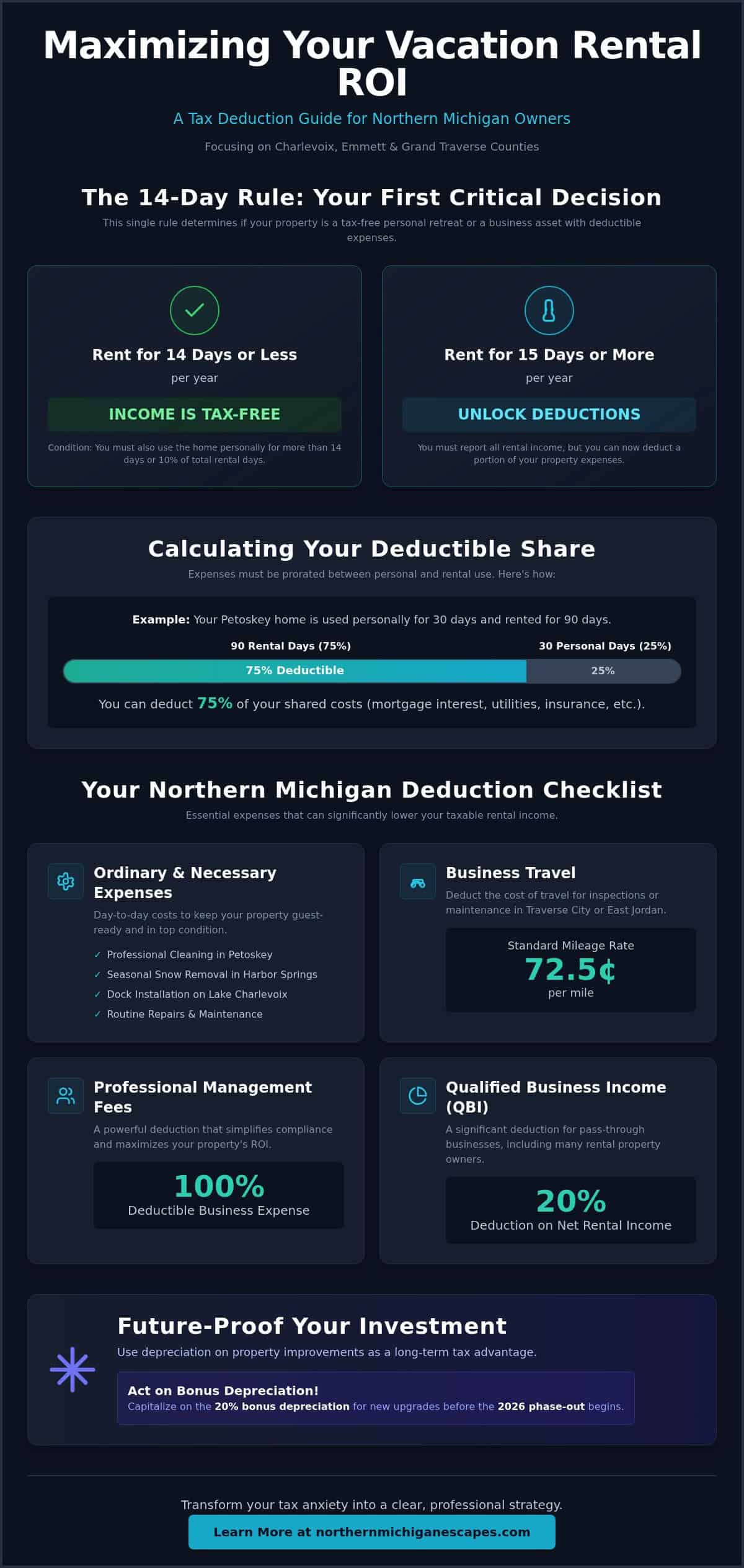
The IRS looks at your lakeside cottage or mountain chalet through two distinct lenses: a personal sanctuary or a business enterprise. The pivot point between these two worlds is the 14-day rule, often called the Masters Rule. This regulation provides a unique opportunity for homeowners in high-demand areas like Traverse City or Harbor Springs to generate income without the typical tax burden. If you rent your home for 14 days or fewer during the calendar year, you don’t have to report that income on your federal tax return. It’s a rare gift from the tax code that favors owners in premier vacation destinations.
To better understand how these classifications impact your bottom line, watch this helpful video:
The 14-Day Tax-Free Rental Loophole
For owners near Boyne Mountain or those with Lake Charlevoix vacation rentals, this loophole is particularly lucrative during peak event weeks. Imagine renting your property during the National Cherry Festival in Traverse City or a major ski competition in Boyne Falls. As long as you stay within the 14-day limit, those high-premium rental checks are entirely tax-free. To qualify, you must also use the home for personal purposes for more than 14 days or 10% of the total days it’s rented to others. Careful documentation of every calendar date is non-negotiable. If you exceed the limit by even one day, the IRS requires you to report every dollar earned.
Classifying Your Northern Michigan Property
Once you rent your property for 15 days or more, it transitions into a rental property in the eyes of the IRS. This shift unlocks the door to utilizing a comprehensive vacation rental tax deductions guide to offset your earnings. You’ll need to calculate the ratio of rental use versus personal use to determine which expenses are deductible. For instance, if you spend 30 days enjoying your Petoskey home and rent it out for 90 days, 75% of your shared costs become business deductions.
The IRS is particularly attentive to whether you’re charging a fair rental value. If you rent to friends at a steep discount, those days may count as personal use instead of business days. This classification also impacts your ability to claim a loss. If your personal use exceeds the 14-day or 10% threshold, your deductions are generally limited to your rental income. However, for those focused on a long-term strategy, understanding Depreciation and Capital Improvements is essential for properties that fully qualify as business investments. Proper classification ensures you aren’t just guest-ready, but also audit-ready.
Essential Operating Expense Deductions for Northern Michigan Rentals
Owning a piece of Northern Michigan’s landscape is a privilege that comes with unique operational demands. To keep your investment performing at its peak, you must look beyond the guest experience and focus on the ledger. Every dollar spent maintaining the pristine condition of your property can potentially lower your tax liability. This vacation rental tax deductions guide emphasizes the importance of distinguishing between ordinary expenses and luxury upgrades. While a new gold-plated faucet might be a personal choice, the routine repair of a leaky pipe in a Traverse City condo is a deductible necessity.
According to the IRS, Essential Operating Expense Deductions must be both ordinary and necessary for managing and maintaining your rental property. For owners in our region, this includes the high standards of cleanliness expected by discerning travelers. Professional housekeeping isn’t just about hospitality; it’s a critical business operation. Meticulous records of turnover services in Harbor Springs or Petoskey provide the paper trail your CPA needs to justify these costs. Similarly, utilities like heat, water, and high-speed internet are fully deductible when the property is used exclusively for guests. For seasonal retreats, you’ll simply prorate these costs based on the rental days we discussed in the previous section.
Seasonal Maintenance and Regional Costs
In Boyne Falls and Petoskey, snow removal isn’t a luxury; it’s a survival requirement for winter bookings. Costs for plowing driveways, shoveling walkways, and professional roof raking to prevent ice dams are all fully deductible. If you own one of the many coveted Lake Charlevoix vacation rentals, the seasonal rhythm of dock installation and removal is another regional expense you should track. These recurring costs, along with professional winterization and spring landscaping in East Jordan or Boyne City, are essential to preserving the property’s value and ensuring guest safety throughout the year. Partnering with professional property services ensures these local maintenance tasks are handled reliably and documented for your tax records.
Marketing, Insurance, and Administrative Fees
Reaching the right audience requires a presence on major platforms and local listing sites. The fees you pay for advertising your home are 100% deductible. You should also account for specialized short-term rental insurance premiums. Standard homeowner policies often don’t cover commercial activity, making these specific premiums a necessary business expense for your peace of mind. Finally, don’t overlook the administrative side of ownership. The fees you pay for legal advice regarding local ordinances or the professional accounting services used to prepare your year-end statements are all valid deductions that help protect your Northern Michigan investment.
Depreciation and Capital Improvements: Long-Term Tax Strategy
While seasonal bookings provide the immediate thrill of income, the true strength of your investment lies in the sophisticated use of depreciation. This non-cash expense allows you to deduct the cost of your property over time, effectively lowering your taxable income without a single dollar leaving your pocket. This vacation rental tax deductions guide emphasizes how depreciation serves as a hidden engine for your property’s financial performance, preserving capital for owners of high-end estates in Harbor Springs or sprawling acreage in East Jordan.
The IRS distinguishes sharply between a simple repair and a capital improvement. Fixing a torn screen at your Petoskey rental is a deductible repair, which you can write off entirely in the year it occurs. However, replacing that same screen with a custom-built sunroom is an improvement. These enhancements must be depreciated over several years, as they add significant value or prolong the life of the property. For those managing Boyne Mountain vacation rentals, understanding this distinction is the difference between a minor tax break and a major long-term financial shift.
As of 2026, the bonus depreciation rate has moved to 20%. This allows you to immediately deduct a portion of the cost of eligible assets, such as new furniture or appliances, rather than waiting decades. It’s a powerful incentive for owners looking to refresh their interiors in Traverse City or upgrade their outdoor living spaces along Lake Charlevoix. By accelerating these deductions, you can significantly offset your rental income during years of heavy investment.
The 27.5-Year Depreciation Schedule
Residential rental property is depreciated over a 27.5-year period. One critical step for Northern Michigan owners is separating the value of the building from the value of the land. Since land doesn’t wear out, it cannot be depreciated. Whether you own a waterfront lot in Charlevoix or a wooded retreat in Boyne Falls, your appraisal should clearly delineate these values. According to IRS Publication 527, this systematic deduction is one of the most effective ways to boost your ROI. Just keep in mind that when you eventually sell, the IRS may recapture some of this depreciation, taxing it as income unless you utilize a 1031 exchange.
Smart Improvements for Resort Properties
In a competitive market, luxury amenities are the signature promise of a premier getaway. Expanding a deck to capture better sunset views over Traverse City or installing a high-end kitchen in a Harbor Springs manor are strategic capital improvements. These projects increase your tax basis, which can reduce your capital gains tax when it’s time for real estate sales and acquisitions. Other popular additions include:
- Professional-grade hot tubs for après-ski relaxation in Boyne Falls.
- Stone outdoor fire pits for summer evenings in Petoskey.
- Upgraded HVAC systems to ensure year-round comfort in Boyne City.
Meticulous documentation of these upgrades ensures that every enhancement is accounted for, maximizing your future resale value and current tax benefits. This disciplined approach to record-keeping transforms a simple property into a high-performing financial asset.
Overlooked Deductions: From Management Fees to Travel
The path to a higher ROI often winds through the smaller details of your daily operations. While major expenses like mortgage interest are obvious, many owners overlook the cumulative power of smaller, recurring costs. This vacation rental tax deductions guide highlights how the professional fees you pay to ensure a seamless guest experience are also some of your most reliable tax advantages. Commissions paid for full-service property management are 100% deductible business expenses. These fees cover everything from marketing your home in Traverse City to coordinating repairs in Boyne Falls, effectively reducing your taxable income while freeing you from the burdens of daily oversight.
Hospitality is the heartbeat of a successful rental, and the IRS recognizes the costs associated with making guests feel at home. You can write off the expense of guest amenities that define the local belonging experience. Welcome baskets filled with local treats, artisan coffee sourced from East Jordan, or high-end toiletries for your Harbor Springs retreat are all valid business deductions. These small touches do more than earn five-star reviews; they serve as legitimate operational costs that support your bottom line.
The Power of the QBI Deduction
One of the most significant benefits for eligible owners is the Qualified Business Income (QBI) deduction. This allows you to deduct up to 20% of your qualified business income from your taxes. To qualify, your rental activity must rise to the level of a trade or business. The IRS provides a safe harbor for those who can prove at least 250 hours of service per year toward the rental enterprise. This includes time spent on maintenance, guest communication, and even supervising repairs in Petoskey. Partnering with a professional team helps establish the meticulous record-keeping needed to prove this active involvement, ensuring your property is viewed as a legitimate business rather than a passive hobby.
Travel and Transportation Log
Your trips to Northern Michigan to check on your investment are more than just a getaway; they’re essential business inspections. For the 2026 tax year, the IRS standard mileage rate is 72.5 cents per mile. Whether you’re driving from downstate to meet a contractor in Charlevoix or heading to a hardware store in Boyne City for supplies, those miles add up. You can also deduct airfare and lodging if the primary purpose of your trip is the management or maintenance of your rental. To survive an audit, you must maintain a contemporaneous log. This record should detail the date, the business purpose of the trip, and the specific mileage or expenses incurred.
Maximizing these benefits requires a partner who understands the intersection of luxury hospitality and financial performance. If you want to streamline your operations and ensure every eligible expense is captured, explore our full-service property management solutions to see how we protect your investment year-round.
Professional Management: Simplifying Compliance and Maximizing ROI
The journey of property ownership in Northern Michigan should feel like a retreat, not a second job spent hovering over complex spreadsheets. While the previous sections of this vacation rental tax deductions guide have detailed the specific write-offs available to you, the most significant efficiency often comes from how you choose to manage the property itself. Full-service management fees are a 100% deductible business expense. This means the cost of professional oversight is directly offset by the tax savings it generates, effectively paying for the expertise that protects your asset. This arrangement transforms a complex operational burden into a streamlined financial asset, allowing you to enjoy the prestige of ownership without the administrative weight.
Centralized expense tracking is the quiet hero of a successful tax season. Instead of hunting for scattered receipts from hardware stores in East Jordan or emergency plumbing services in Harbor Springs, professional management provides a single, authoritative source of truth. At year-end, your CPA receives a clean, itemized financial report that reflects every dollar spent on maintenance, marketing, and professional housekeeping. This level of meticulousness reduces the stress of tax season and ensures you never miss a valid deduction; it’s a level of reliability that software-only solutions simply cannot match. By centralizing these records, you maximize your ROI across your entire portfolio in Grand Traverse and Emmett counties.
The Northern Michigan Escapes Advantage
Our local team in Charlevoix and Petoskey acts as your sophisticated local guide, managing the intricate dance of vendor coordination and guest relations with precision. We handle the seasonal shifts that define our region, from the heavy snow removal needs in Boyne Falls to the meticulous spring preparations required in Boyne City. Each month, you receive a detailed statement that makes itemizing your deductions effortless. This transparency is a hallmark of our commitment to your peace of mind and financial performance. You can learn more about our full-service property management to see how we elevate the standard of care for your investment while simplifying your year-end reporting.
Maximizing Your Investment Sanctuary
Balancing the emotional allure of a personal vacation home with the rigorous demands of a high-performing business is a delicate art. Local expertise is essential for navigating the specific market dynamics of Traverse City and the surrounding lakeside enclaves. By positioning your property for maximum occupancy during peak seasons, you generate higher revenue while simultaneously creating a larger pool of deductible offsets for your operating costs. Whether you are optimizing a Boyne Mountain vacation rental or a waterfront estate on Lake Charlevoix, the goal is to create a sanctuary that performs as well on your tax return as it does for your guests. Taking these professional steps ensures your investment remains a source of pride and prosperity for years to come.
Secure the Future of Your Northern Michigan Retreat
Transforming your lakeside cottage or mountain chalet into a high-performing financial asset requires more than just hospitality; it demands a meticulous approach to the tax code. By mastering the 14-day rule and leveraging the 2026 depreciation rates, you ensure that your investment in Traverse City or Harbor Springs remains as rewarding as it is beautiful. This vacation rental tax deductions guide provides the foundation for navigating complex regional costs, from snow removal in Petoskey to dock maintenance on Lake Charlevoix. Every documented expense is a step toward a more resilient bottom line.
Since 2004, we’ve provided specialized local expertise to owners across Boyne City, East Jordan, and Boyne Falls. Managing over 250 premium rentals, our team delivers the comprehensive financial reporting your CPA needs to maximize every eligible deduction. Explore our professional property management services to maximize your ROI and reclaim your peace of mind. Your dream of a stress-free investment is within reach; let us handle the fine details while you enjoy the timeless beauty of the North.
Frequently Asked Questions
Is the 14-day rule still applicable if I use the property for personal reasons?
Yes, the 14-day rule is actually dependent on your personal use of the home. To keep your rental income tax-free under this provision, you must use the property for personal purposes for more than 14 days or 10% of the total days it’s rented, whichever is greater. If you meet these personal use requirements and rent the home for 14 days or fewer, you don’t have to report the income or deduct any rental-related expenses.
Can I deduct the cost of property management fees in Northern Michigan?
Yes, property management fees are 100% deductible as an ordinary and necessary business expense. Whether you’re paying for professional marketing in Traverse City or coordination of repairs in Charlevoix, these commissions directly reduce your taxable rental income. This makes professional oversight a financially efficient choice for owners who want to enjoy the prestige of a luxury investment without the daily administrative burden.
What is the difference between a repair and a capital improvement for tax purposes?
A repair maintains the property’s current condition, while an improvement increases its value or extends its useful life. For example, fixing a leaky faucet in East Jordan is a repair you can deduct immediately in the current tax year. Conversely, installing a new energy-efficient HVAC system in Boyne City is a capital improvement that you must depreciate over time as outlined in this vacation rental tax deductions guide.
How do I qualify for the 20% Qualified Business Income (QBI) deduction?
You qualify for the QBI deduction by establishing that your rental activity rises to the level of a trade or business. The IRS provides a safe harbor for owners who can document at least 250 hours of service per year toward their rental enterprise. This includes time spent on maintenance, guest communication, and supervising property improvements in Harbor Springs or Petoskey, making detailed logs of your active involvement essential.
Are cleaning and turnover fees paid by guests considered taxable income?
Yes, any cleaning or turnover fees you collect from guests are considered part of your gross rental income. However, the actual cost you pay for professional housekeeping services in Boyne Falls is a fully deductible business expense. This usually results in a net-zero impact on your taxable income, ensuring you aren’t penalized for the funds passed through to maintain the high standards of your retreat.
Can I deduct travel expenses if I live in another state but own a rental in Petoskey?
You can deduct travel expenses as long as the primary purpose of your trip is the management or maintenance of your rental property. For 2026, the IRS standard mileage rate is 72.5 cents per mile for business use of a vehicle. If you fly to Northern Michigan specifically to oversee renovations or conduct a deep-cleaning inspection, your airfare and lodging costs may also be eligible for deduction.
What records do I need to keep to support my vacation rental tax deductions?
You should maintain a meticulous log of all rental and personal use days alongside every business-related receipt and invoice. This includes a contemporaneous record of mileage for trips to Traverse City or local supply stores and copies of all guest contracts. Accurate, real-time record-keeping is the only way to successfully support your vacation rental tax deductions guide and protect your investment during an audit.
How does depreciation work for a short-term rental property?
Depreciation allows you to deduct the cost of the building over a 27.5-year period as a non-cash expense that lowers your taxable income. In 2026, you can also utilize a 20% bonus depreciation rate for qualified assets such as new furniture or appliances placed in service during the year. This strategy helps offset the revenue generated by your Lake Charlevoix or Boyne Mountain property, significantly enhancing your annual cash flow.